Written by Trinity “Ryen” Bird Reed, EBCI Tribal Option Care Manager
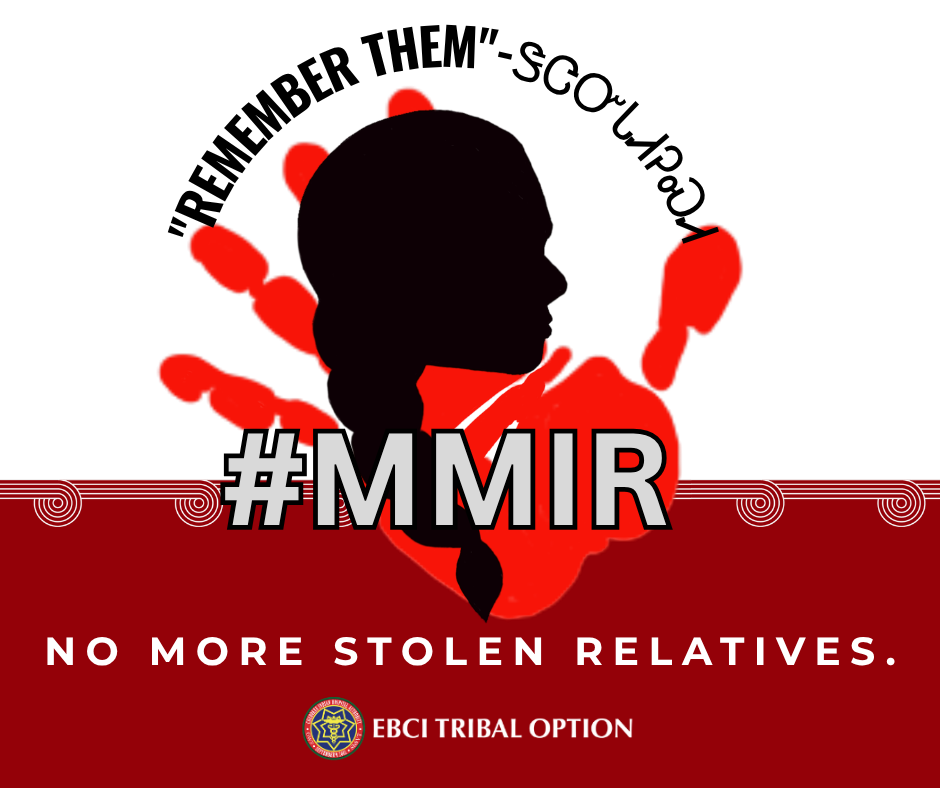
Each year, led by the National Indigenous Women’s Resource Center (NIWRC), communities across Indian Country recognize Missing and Murdered Indigenous Relatives (MMIR) Week as a time to honor those who are missing, remember those we have lost, and stand in solidarity with the families who continue to carry this burden. This year, the National Week of Action for Missing and Murdered Indigenous Women and Relatives will take place May 4-8.
For the Eastern Band of Cherokee Indians (EBCI), this is a deeply personal issue that has unfortunately impacted our families and has become our community responsibility to protect one another.
The MMIR crisis continues to impact Indigenous communities at alarming rates across the United States:
• More than 5,700 cases of missing American Indian and Alaska Native women and girls were reported in a single year, yet only a fraction were reflected in federal databases.
• Murder is the third leading cause of death for American Indian and Alaska Native women and girls, according to the Centers for Disease Control.
• More than four in five American Indian and Alaska Native women (84.3%) have experienced violence in their lifetime.
• 56.1% have experienced sexual violence, 55.5% have experienced physical violence by an intimate partner, and 48.8% have experienced stalking, according to the National Institute of Justice.
• In some Tribal communities, Native women are murdered at rates more than 10 times the national average.
• 84% of Indigenous women experience violence in their lifetime, with more than half experiencing sexual violence.
Behind every statistic shared to raise awareness is a name, a family, and a story that deserves to be remembered, which is why the EBCI continues to elevate awareness through community-led initiatives and partnerships focused on education, advocacy, and support. The Qualla Boundary Missing and Murdered Indigenous Women initiative invites community members and allies to gather, remember, and stand together for the 7th Annual Missing and Murdered Indigenous Relative Awareness Walk on Saturday, May 2nd at the Oconaluftee Island Park from 3pm to 5:30pm.
This is a community-led and community-funded gathering focused on honoring the lives of our missing or murdered Indigenous relatives. It is a space to stand beside families, to remember those who are no longer with us, and to walk together toward healing and lasting change.
The MMIR crisis is deeply connected to broader issues, including access to healthcare, mental health support, housing stability, and systemic gaps in reporting and jurisdiction. Many cases go underreported or unresolved due to fragmented data systems and jurisdictional challenges between Tribal, state, and federal agencies. Access to care and support services plays a critical role in both prevention and healing.
Through the Cherokee Indian Hospital Authority, programs like the SAFE (Sexual Assault Forensic Examiner) Nurse Program provide trauma-informed care for survivors of violence. These trained professionals offer compassionate, confidential care, forensic exams and documentation, support through the reporting process, and connection to additional medical and behavioral health services.
EBCI Tribal Option Care Management also works alongside individuals and families to connect them with essential services, including behavioral health support, safety resources, and care coordination. If you or someone you know needs help, reaching out is a powerful first step.
MMIR Week is about more than awareness it is about action, remembrance, and community strength.
It is about speaking the names of those we have lost.
It is about supporting the families who continue to search for answers.
It is about ensuring future generations are safer, seen, and protected.
Throughout the week, the community will gather, walk, and remember and through that unity, we continue the work toward justice, healing, and change. May 5th is recognized as the National Day of Awareness for Missing and Murdered Indigenous Women and Girls (MMIWG), often referred to as Red Dress Day. This day honors missing and murdered Indigenous women, girls, and two-spirit people, while raising awareness about the high rates of violence against Native women.